
Lead Follow-Up
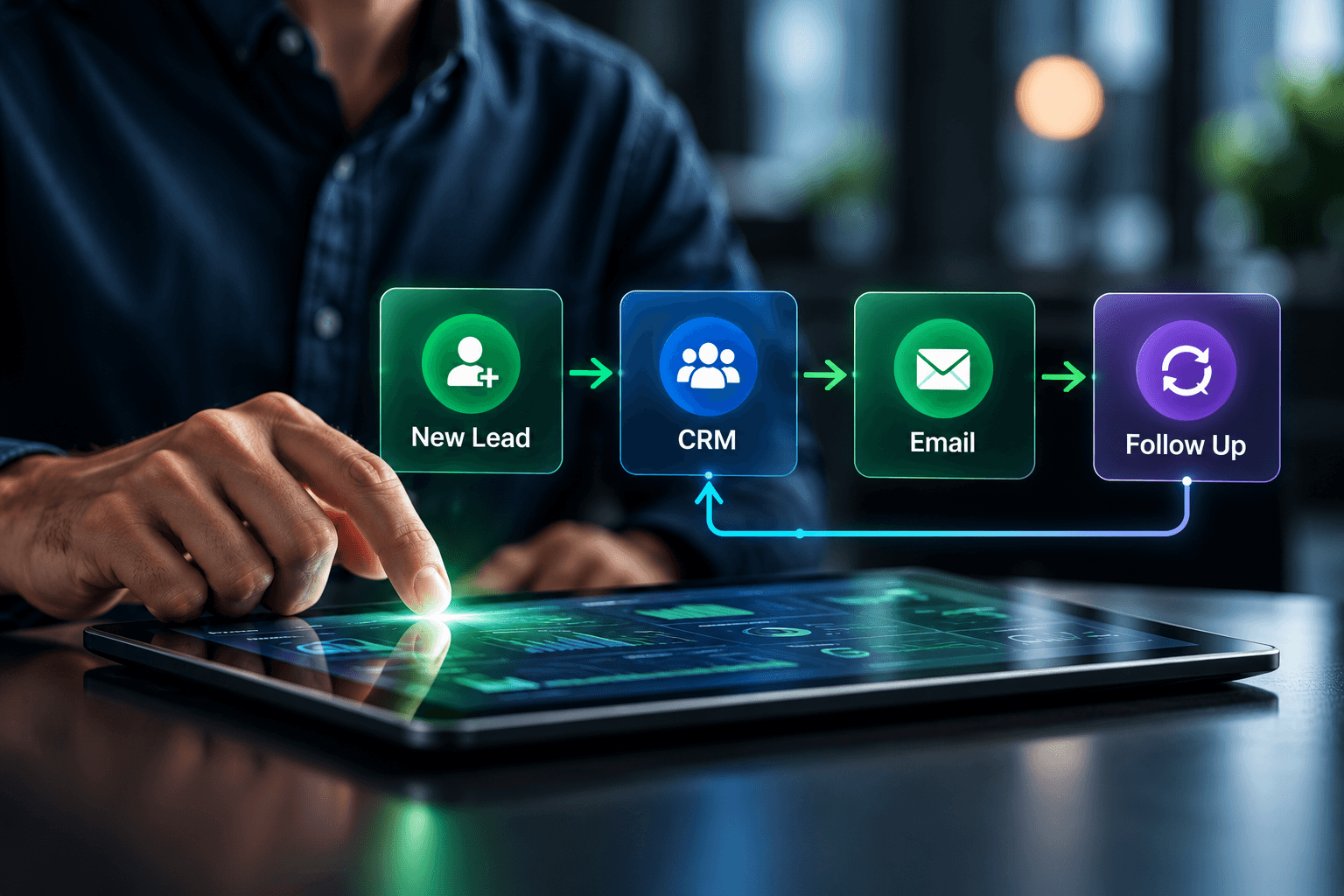
Confirm new inquiries, notify the right person, create a record, and schedule follow-up without waiting for someone to notice an email.
Business Automation
Connect the tools you already use, automate routine follow-up, reduce duplicate entry, and keep work moving without adding more manual steps.
Show us how the work happens today and where your team loses time. We’ll determine where automation can help.
Confirm new inquiries, notify the right person, create a record, and schedule follow-up without waiting for someone to notice an email.
Send confirmations, reminders, status updates, review requests, and other messages automatically when the right event occurs.
Reduce duplicate entry by moving information between supported systems instead of asking employees to copy it by hand.
Generate proposals, reports, PDFs, spreadsheets, and routine communications using information your business already has.
Automate appointment confirmations, reminders, internal notifications, and the handoffs that keep scheduled work moving.
Assign tasks, request approvals, update statuses, notify employees, and trigger the next step when something changes.
You do not need to automate everything. The best projects usually start with one process that is frequent, predictable, and frustrating enough to be worth fixing.
The same task, follow-up, transfer, or report happens often enough that manual effort adds up.
There is a recognizable trigger, decision, or next step that can be defined clearly and handled consistently.
Removing the manual work saves meaningful time, reduces mistakes, improves follow-through, or creates a better customer experience.
Lead follow-up, data transfer, reminders, document generation, recurring reports, and task handoffs.
Rare edge cases, highly subjective decisions, or processes that are still changing constantly.
Discovery before development
If a workflow crosses multiple people, systems, or departments, a quick conversation may not be enough to define the right solution.
We document how the process works today, identify where time or information is being lost, and define what a better workflow could look like.
We keep the project grounded in what the business actually needs to accomplish.
Show us how the work happens today—the spreadsheets, emails, paperwork, software, and manual steps that are creating frustration.
We identify duplicated effort, bottlenecks, unnecessary steps, and places where automation could create meaningful value.
We explain what we recommend, what it should accomplish, and what it will cost before development begins.
We develop the workflow and test it against real-world scenarios before putting it into production.
Third-party systems change. APIs are updated. Business processes evolve. Automation Care provides ongoing monitoring, maintenance, and technical support for the workflows your business relies on.
New functionality and significant workflow changes are quoted separately.
Business automation projects typically start around $3,500. Smaller, well-defined automations may cost less, while projects involving several systems or custom interfaces can cost considerably more.
Usually not. In many cases the best solution is to keep the tools that work and improve the connections and workflow around them.
For projects that require meaningful discovery, we review the current process, identify improvement opportunities, define the recommended future workflow, and develop a scoped implementation proposal.
No. If you choose 4G Creative to implement the recommended solution, 100% of the assessment fee is credited toward that project.
Yes, when AI is genuinely useful. Examples can include document extraction, classification, summarization, routing, knowledge search, and other tasks where AI produces a practical business benefit.
That is one reason Automation Care exists. APIs and third-party systems change, and ongoing monitoring and maintenance can help keep important workflows operating.